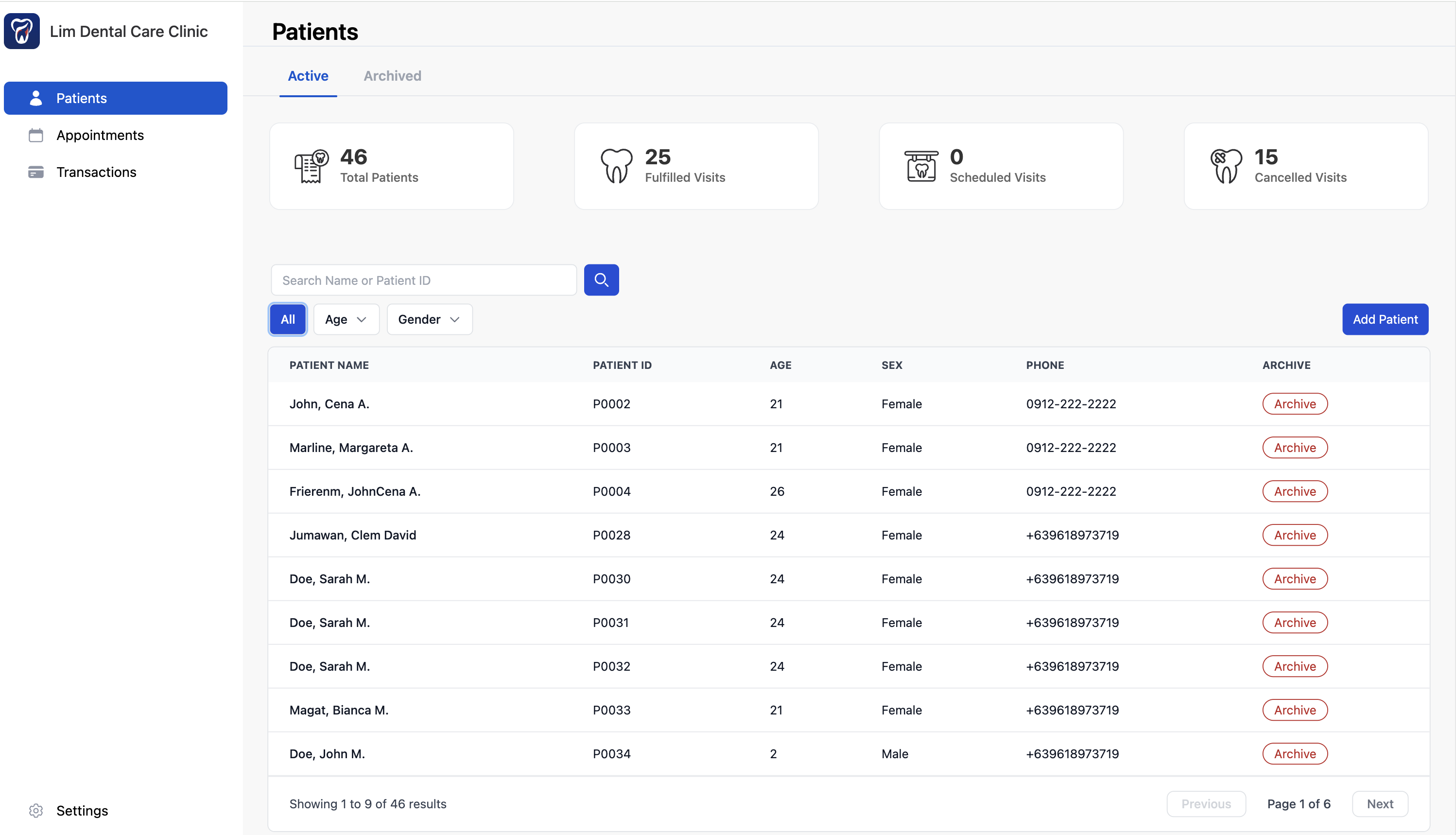
Dental Clinic Management System
Unifying appointment scheduling, patient records, and transaction management into one system.
Problem
Dental clinics still relied on manual, fragmented processes for patient records, appointment bookings, and payment tracking — leading to missed visits, billing errors, and inconsistent data across staff.
Solution
We designed and built a centralized clinic management platform following a design thinking process — going from staff interviews to deployed system across five core modules.
Outcome
Built a centralized platform with 5 core modules covering patients, appointments, transactions, and automated SMS. Pivoted from Twilio to HttpSMS weeks before the deadline and shipped on time.
Client
Lim Dental Care Clinic
Role
Designer & Developer in a 5-person team
Timeline
Aug 2024 – Apr 2025
Problem
Many dental clinics still relied on manual, fragmented processes for patient records, appointment scheduling, and payment tracking — leading to missed bookings, billing errors, and data inconsistencies across staff.
Process
Coming soon.
Takeaways
- Design with users in mind. Real interviews helped us turn pain points into practical features.
- Balance scope and feasibility. Not all ideas were buildable — prioritization was key.
- Embrace iteration. Frequent feedback helped us refine the system to meet real needs.
- Adapt under pressure. We pivoted from Twilio to HttpSMS weeks before the deadline.
- Communicate clearly. Working with non-technical stakeholders taught me to explain design choices simply.
Stack
 React
React Bootstrap
 Django
 Python
 MySQL
MySQL Figma
Figma Twilio
 Calendly
 cPanel
This case study highlights only key parts of the project.
Certain details are withheld due to an NDA, but if you're curious about the full story, I'd love to chat.